
by John Lindsay-Poland
International Policy Journal, June 15, 2026
In April, U.S. prosecutors indicted the sitting governor of Sinaloa state in Mexico along with nine other current and former officials for colluding with the Sinaloa Cartel to traffic fentanyl and other narcotics into the United States, and for violence carried out by cartel gunmen armed with machineguns and other firearms. Two of the officials have since turned themselves in to U.S. authorities – presumably to turn state’s evidence – while the rest remain in Mexico. The Trump administration declared the cartel as a foreign terrorist organization last year, so the indictment charges Mexican officials with colluding with terrorists.
During 2017 through 2020, the years that some of those same Sinaloa officials were allegedly colluding with the cartel, the United States licensed gun companies to legally export weapons that went to the Sinaloa police forces the officials ran – licenses that were approved or extended by the State Department during Trump’s first term.
Sig Sauer, Inc., based in New Hampshire, exported at least 243 firearms to Sinaloa state and municipal police from 2016 to 2020. During that time, José Antonio Dionisio Hipolito was Director of Sinaloa State Police and is accused in the indictment issued yesterday of being on the cartel monthly payroll.
Sig Sauer and Glock were founded and are still owned by Europeans. Sig Sauer’s CEO, Ron Cohen, was arrested in Germany in 2018 after firearms produced in that country for export to the United States were re-exported to Colombia, without a German export license to do so. (He was later released.) Since then, Sig has moved all of its production to New Hampshire. Glock is Austrian, but beginning in 2022, it began exporting thousands of firearms to Mexico from its U.S. production location in Georgia, according to Arms Trade Treaty records.
Glock exported 11,125 handguns to Mexico in 2022-2023. At least 58 of these firearms were sold to Sinaloa state and local police agencies during those two years, according to receipts for these transfers obtained through a public records request to the Mexican army.
During 2022-2023, according to the indictment, Dionisio Hipolito as well as other state and local police officials in Sinaloa were colluding with the cartel in exchange for bribes.
Mexico legally imports, by far, more firearms from the United States than any other Latin American country, in some years nearly as much as the rest of the region combined. The growth of such U.S. gun exports began with the Mérida Initiative in 2008, a U.S. assistance plan modeled on the militarized approach of Plan Colombia, but these sales continued after military and police assistance declined in 2010. It just meant that Mexico bought the weapons and other gear from U.S. companies, instead of having them paid for by U.S. taxpayers.

In some respects, this reflects an arms race of the Mexican military with criminal organizations, which have nearly unlimited access to military-grade weaponry in the U.S. retail gun market, and plenty of cash. But the acquisition of ever great amounts of weaponry by the state also assumes that the most effective means of weakening these criminal organizations, whose raison d’etre is to make money, is through military force. This turns out not to be true.

Since the declaration of the drug war in 2007 in Mexico, there have been more than 450,000 homicides and over 120,000 disappearances, most carried out by or against criminal groups, although many victims were simply in the wrong place, or fell to armed misogyny or conflicts between individuals.
Enter Trumpian hubris. Its peculiarity is to believe that going after the heads – of states or criminal groups – will eliminate the structural problems that lead to their behaviors. The current version builds on the kingpin strategy, in place for decades, by which the United States arrests or kills leaders of narcotics traffickers, who are then replaced through bloody succession battles.
Guns R Us
Even more U.S. weapons flow through the illicit trade to the Sinaloa Cartel and others in Mexico from retail gun shops and private sales in southwestern states. Between 70% and 80% of firearms seized in Mexico and submitted for tracing came from the United States. According to an investigation published in 2023 by N+, when one of the sons of cartel capo ‘El Chapo’ Guzmán was arrested earlier that year, dozens of weapons recovered during the operation were traced to gun purchasers in Arizona and Texas who illicitly trafficked them directly to his faction of the Sinaloa Cartel – the same faction that the Justice Department is now accusing of bribing state government officials in Sinaloa.
The pipeline of weapons trafficked from Arizona to Sinaloa has only gotten worse since then, according to data obtained from the Bureau of Alcohol, Tobacco, Firearms and Explosives (ATF). In 2024, an intra-cartel war erupted in Sinaloa after one of its leaders, ‘El Mayo’ Zambada, was betrayed by a competitor and shipped to the United States. Last year, the Mexican army seized more than twice as many crime guns in Sinaloa as in any other Mexican state.
In 2024, according to ATF data, most crime guns trafficked to Mexico with a short “time to crime” – the time between purchase and confiscation in Mexico, a key indicator of deliberate trafficking – came from one state. 62% of U.S.-sourced guns with a time-to-crime of a year or less were procured from Arizona. In fact, a majority of these firearms were purchased in a single county – Maricopa County, where Phoenix is located. Arizona and Texas, even more than most states, have enormous, permissive and militarized retail gun markets. There, if you have the cash, it is easy to purchase a .50 caliber Barrett rifle that can penetrate armor and shoot down helicopters. It can even be done without a background check.
In other words, U.S. weapons go both from U.S. retail gun shops to the cartel that the U.S. has designated a foreign terrorist organization, and through licensed exports to police forces that the U.S. Department of Justice says collude with the cartel.
The Trump administration is beholden, politically and ideologically, to the firearms industry, whose vision of peace is no-holds-barred on weapons commerce. The ATF recently announced over 30 changes to firearms regulations that will make it easier to traffic weapons over the border to cartels in Mexico.
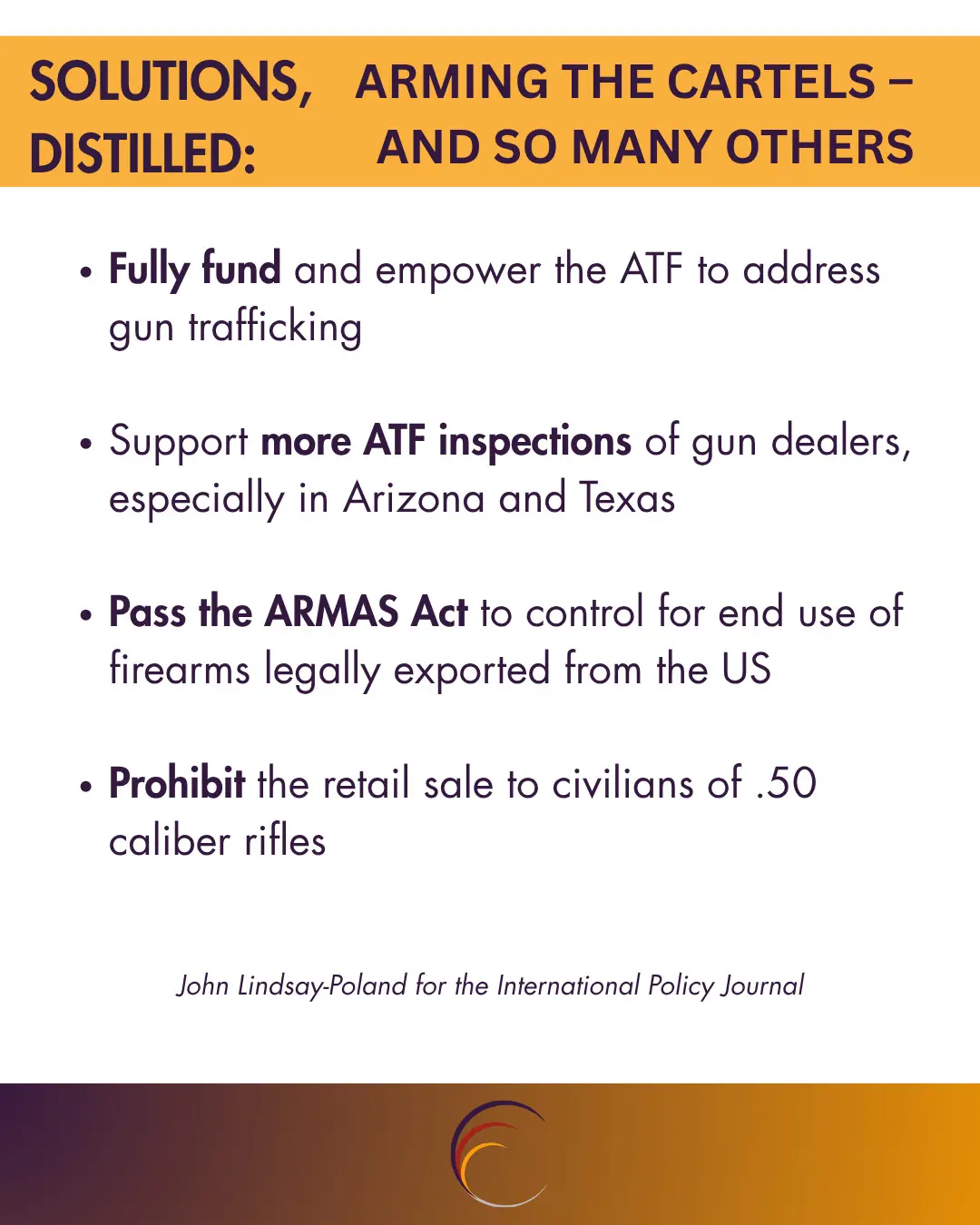
Still, if the administration has political will to weaken the hold of violent cartels in Mexico, it can effectively address its means of violence by focused efforts to reduce the illicit traffic of weapons to them from gun retailers. In March, the DOJ indicted an Arizona gun dealer for selling weapons to cartel operatives and materially supporting a foreign terrorist organization. It could do more by deploying the ATF to inspect gun dealers instead of removing their enforcement authorities.
It should also control the end use for legally exported U.S. firearms to exclude police and military forces credibly documented to collude with criminal groups or violate human rights. The administration could accomplish this through policy or support for congressional passage of the ARMAS Act, which would establish stronger transparency and accountability for the export of U.S. firearms, while also increasing interagency coordination and international incentives to disrupt firearms trafficking.
Finally, the federal government should prohibit the retail sale to civilians of .50 caliber rifles highly desired by cartels through passage of the Stop Arming Cartels Act.
U.S. firearms enable a wide range of violence in Mexico and the United States – narcotics trafficking, violent conflict between criminal groups and state forces, homicides, forced disappearances, extortion, femicides, and control of migration routes. Any strategy seeking to reduce these harms must address the guns that make them possible. Reducing the illicit flow of firearms and working to keep those weapons – both licit and illicit – from those who would further the harm will benefit many thousands of families, on both sides of the border.
John Lindsay-Poland is coordinator of Stop US Arms to Mexico, a project of Global Exchange.
For a full accounting of the weapons and munitions the United States exported to Mexico, check out the Security Assistance Monitor.


